

 Lighting
Commercial solar rebate eligibility Victoria businesses are checking right now has shifted in 2026. The Victorian Energy Upgrades (VEU) commercial solar discount is now in its second year, and the rules around it have shifted. Federal support for mid-sized systems changes on 1 October 2026, and certificate prices have moved since launch. This guide covers every eligibility requirement, what the discount is worth today, and the mistakes that cost businesses their rebate.
In this guide
- Do you qualify? Quick checklist
- What is the VEU commercial solar rebate?
- The 9 eligibility requirements
- How much can your business save?
- Stacking with federal incentives (including the 1 October 2026 change)
- Common pitfalls
- How the process works
- Why check now?
- FAQ
- Glossary
Do You Qualify? Quick Checklist
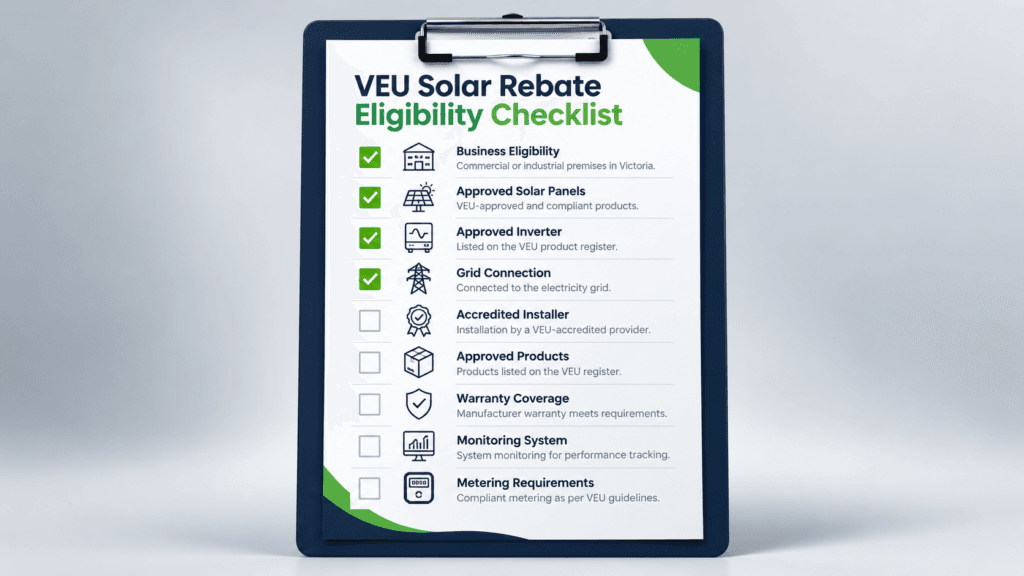
Your business may qualify for the VEU commercial solar rebate if all of these apply:
- Non-residential premises. Commercial, industrial, community or government site (not a Class 2 apartment building).
- System size of 30–200 kW. Measured as solar module (panel) capacity, not inverter size.
- Inverter capacity of at least 30 kVA. As installed and per your DNSP contract.
- DNSP approval. Pre-approval before installation and final approval for grid connection.
- VEU-accredited provider. Accredited for the commercial and industrial solar activity, using qualified designers and installers.
- Approved products. Panels and inverters on the Clean Energy Council (CEC) lists, plus Solar Panel Validation (SPV) participation for smaller systems.
- Minimum warranties. 10 years on panels, 5 years on inverters.
- Monitoring portal. Tracks performance, production and consumption, and you can access it.
- One system per NMI. Staged installs must be claimed together.
If any item doesn’t apply, your system may not qualify. Each is explained below.
What Is the VEU Commercial Solar Rebate
Victorian Energy Upgrades is the Victorian Government’s energy efficiency program, with compliance overseen by the Essential Services Commission (ESC). It works through Victorian Energy Efficiency Certificates (VEECs), each representing one tonne of greenhouse gas emissions abated.
The commercial and industrial (C&I) solar activity (Activity 47, under Part 47 of the VEET Regulations) took effect on 29 September 2025. Before then, commercial solar generally needed a lengthy measurement and verification (M&V) process to earn VEECs. Now, VEECs for eligible 30–200 kW systems are calculated using a deemed method, based on system size and set assumptions, and the value is applied as an upfront discount on your installation.
You don’t lodge a rebate application. Your accredited provider creates the VEECs, and you sign a VEEC assignment form giving them the right to do so. The discount should appear as a line item on your quote and tax invoice.
The 9 Eligibility Requirements
1. Your premises must be non-residential
The activity must take place at a grid-connected, non-residential site. Eligible examples include:
- Factories, warehouses and manufacturing sites
- Offices and retail centres
- Schools, universities and TAFEs
- Hospitals and aged care facilities
- Community halls, sports facilities and aquatic centres
- Local government buildings
- NGOs and not-for-profits
Excluded: Class 2 buildings (multi-unit residential such as apartment buildings) and “scheduled activity premises”, unless the site has formally opted in to the program. The VEU rules define residential premises to include Class 1 to 4 buildings and certain sole-occupancy units, so if your site is mixed-use, ask your provider to confirm eligibility in writing.
Systems can be rooftop, canopy, ground-mounted or floating.
2. System size: 30 kW to 200 kW
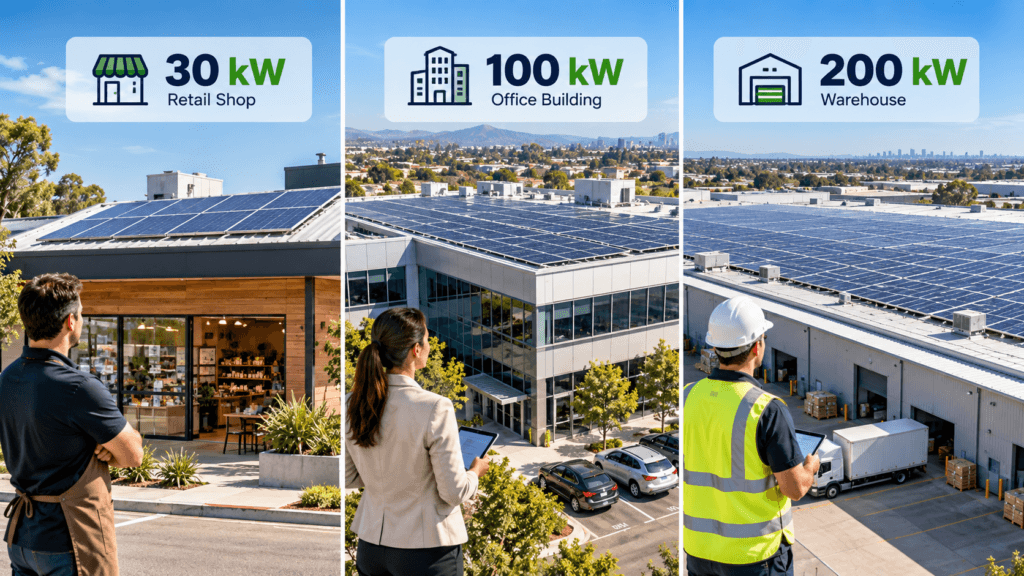
The solar module capacity must be at least 30 kW and no more than 200 kW. This is the panel array rating, not the inverter rating.
The total capacity must be specified in your DNSP contract. Systems above 200 kW can’t claim under this deemed activity, but may be able to use the project-based activity (M&V) pathway instead. You can’t claim the same system under both methods.
3. Inverter capacity of at least 30 kVA
Total connected inverter capacity must be at least 30 kVA as installed and per your DNSP contract. Separately, the ESC guide points to Solar Accreditation Australia (SAA) sizing rules: without a DC-coupled battery, inverter AC output must be at least 75% of the array’s peak power. A 200 kW array therefore needs roughly 150 kVA or more of inverter capacity.
4. Grid connection with DNSP approval
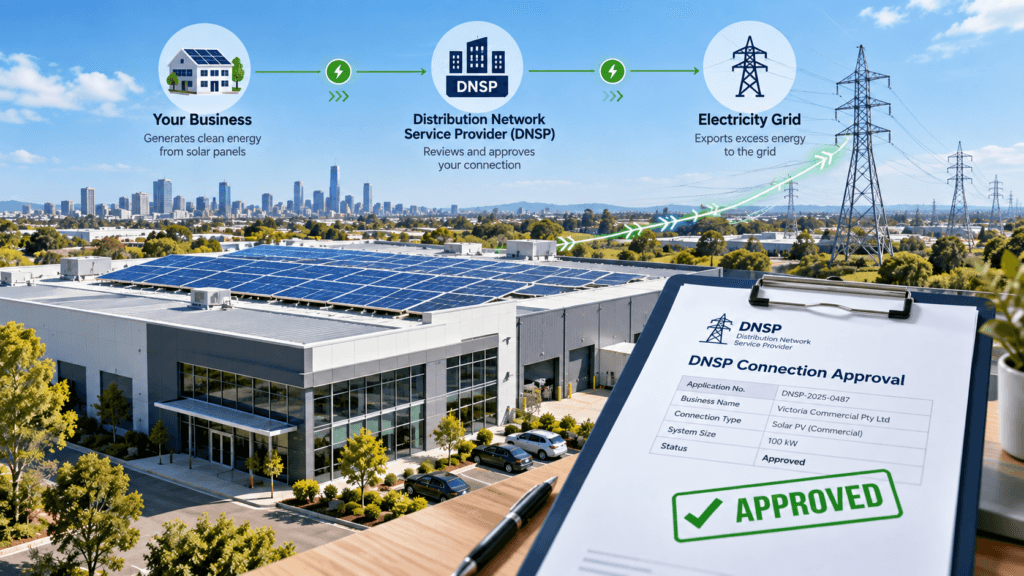
The system must connect to the distribution network and comply with your Distribution Network Service Provider (DNSP) negotiated connection contract. It can be a new connection or a connection alteration.
Your provider needs pre-approval from the DNSP before installation and final approval before VEECs can be created. Approval isn’t automatic and depends on local network capacity, so start early.
5. Installation by a VEU-accredited provider
Only an accredited person approved for the C&I solar activity can create VEECs. Accreditation for other VEU activities, such as lighting, doesn’t cover it, so confirm the specific activity on the ESC’s accredited provider search.
The ESC also sets requirements for the people doing the work:
- A named lead designer and lead installer, registered with the ESC
- Lead designer and installer holding current SAA accreditation
- All electrical work done by a licensed electrician (A Grade), or supervised as the regulations allow
- Working-at-heights and construction induction training for installers
Even a licensed electrician can’t unlock the discount unless the work sits under an accredited provider.
6. Products must be on approved lists
- Panels and inverters must be on the Clean Energy Council approved lists at the time of installation, and not excluded by an ESC determination.
- For smaller systems (Activity 47A), panel manufacturers must be participating brands in the Solar Panel Validation (SPV) Initiative. The ESC guide words this as systems under 100 kW, so confirm the position with your provider if you’re designing at exactly 100 kW.
7. Minimum warranties: 10 years panels, 5 years inverters
Panels need at least a 10-year warranty against defects and inverters at least 5 years. If the warrantor is based overseas, the warranty document must also name an Australian contact for claims. Ask for this in writing before you sign.
8. A monitoring portal you can access
The system must support a monitoring portal that tracks system performance, energy production and energy consumption, and the end user must be able to access it. Check your quote states this and that you’ll receive login details.
9. One system per NMI
Only one solar PV system per National Metering Identifier (NMI) can be installed under the activity, and the NMI must be named in your DNSP contract. What this means in practice, based on the ESC’s guidance:
- Staged installs: if you install 100 kW now and another 100 kW later on the same NMI, VEECs for the whole 200 kW are claimed once, after both stages are energised.
- 200 kW cap: total module capacity under the activity can’t exceed 200 kW as specified in the DNSP contract.
- Extensions and replacements: the ESC recognises new, replacement and extension systems as upgrade types, but the rules here are detailed. If you already have solar at the site, get your provider to confirm in writing whether and how you can claim before you commit.
- Multiple sites: each site with its own NMI is assessed separately.
How Much Can Your Business Save?
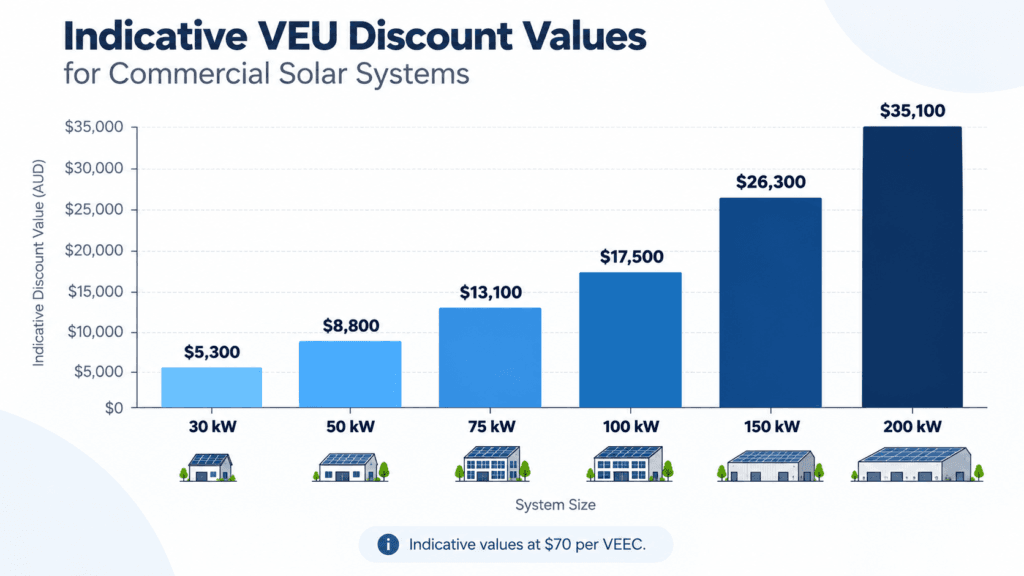
The number of VEECs is set by a formula in the VEU Specifications:
System size (kW) × input factor × 10-year lifetime × regional factor
- Input factor: 0.133 for systems up to 100 kW; 0.25 for systems above 100 kW
- Regional factor: 0.98 for metropolitan Victoria; 1.04 for regional Victoria
The dollar value is then VEECs × the VEEC price. VEEC prices fluctuate. The launch guidance used $70 per VEEC. Current market prices may differ. Your actual discount depends on the VEEC price when certificates are created. The Victorian Government’s launch figures (up to $34,300 for a 200 kW system) assumed $70 per VEEC, so today’s value is higher.
| System size | Approx. VEECs (metro) | Value at $70 (launch guidance) |
| 30 kW | 39 | ~$2,700 |
| 50 kW | 65 | ~$4,600 |
| 75 kW | 98 | ~$6,900 |
| 100 kW | 130 | ~$9,100 |
| 150 kW | 368 | ~$25,700 |
| 200 kW | 490 | ~$34,300 |
Indicative VEEC value based on $70 per VEEC (Victorian Government launch guidance). Actual discount depends on market price at certificate creation
Indicative gross value of VEECs for a metropolitan site, rounded. Regional sites receive about 6% more. Your actual discount depends on the VEEC price when certificates are created and on how your provider passes the value on, so it should be shown as a separate line on your quote.
Why the jump at 100 kW? The input factor rises from 0.133 to 0.25 above 100 kW, reflecting assumed higher on-site solar consumption for larger systems. That’s why a 150 kW system earns far more than 1.5 times a 100 kW system. Size your system to your electricity load and roof, not to a threshold, but do ask your provider to model both options.
Worked example: 120 kW warehouse, metropolitan Melbourne
- VEECs: 120 × 0.25 × 10 × 0.98 = 294
- Indicative VEU discount at $70: about $20,580
- Your quote should then show federal certificates (STCs or LGCs, see below) as a separate line, followed by the amount you pay.
Stacking With Federal Incentives
VEECs can be combined with federal certificates under the Renewable Energy Target:
- 30–100 kW: VEECs plus Small-scale Technology Certificates (STCs).
- 100–200 kW installed before 1 October 2026: VEECs plus Large-scale Generation Certificates (LGCs), which accrue over time as the system generates.
- 100 kW to 1 MW installed from 1 October 2026: the Small-scale Renewable Energy Scheme (SRES) has been expanded, so eligible mid-scale systems can create upfront STCs instead. Per the Clean Energy Regulator, applications open in mid to late November 2026.
At launch, the Victorian Government said that combined with federal incentives, businesses could get up to 35% off the cost of installation. Treat that as a ceiling: actual savings depend on your system, location and certificate prices. STC value also falls over time as the scheme winds down towards 2030, per the DCCEEW, so timing matters.
Common Pitfalls That Cost Businesses Their Rebate
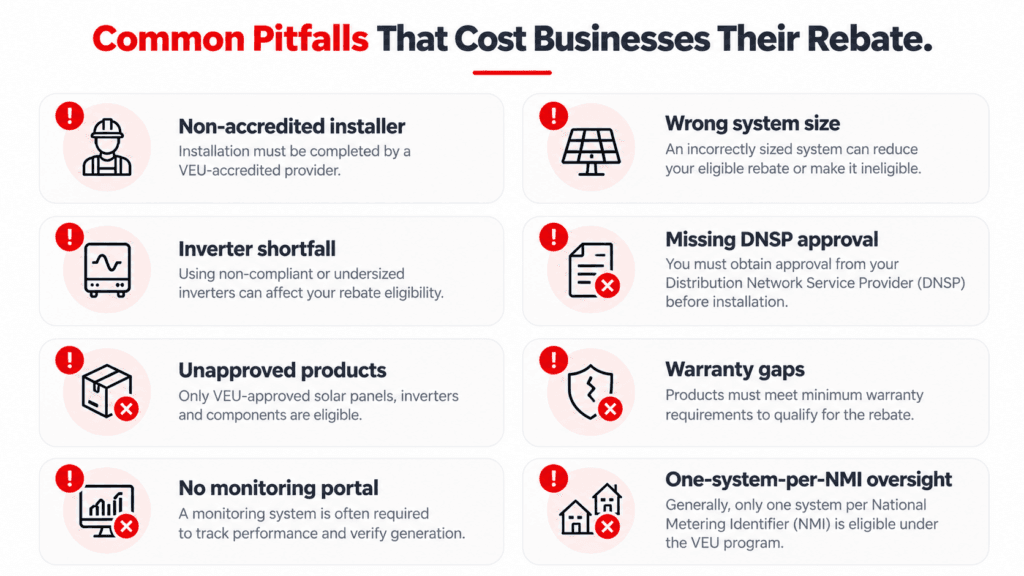
- Using a provider not accredited for the C&I solar activity. General VEU accreditation isn’t enough.
- Wrong system size. Below 30 kW or above 200 kW module capacity doesn’t qualify for the deemed activity.
- Inverter shortfall. Less than 30 kVA installed capacity, or an undersized inverter versus the array.
- Missing DNSP pre-approval or final approval. VEECs can’t be created without final approval.
- Products not on CEC lists, or panel brands outside the SPV initiative where required.
- Warranty gaps. Under 10 years on panels or 5 years on inverters, or no Australian warranty contact.
- No usable monitoring portal.
- Overlooking the one-system-per-NMI rule when staging or extending an install.
How the Process Works
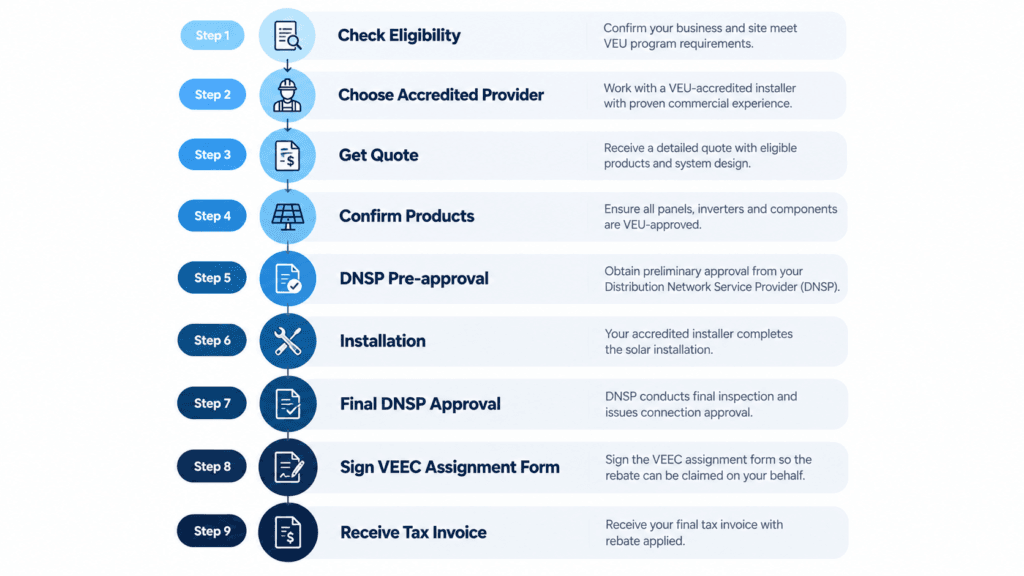
- Check eligibility using this guide.
- Choose a provider accredited for the C&I solar activity.
- Get a quote with site-specific design, expected performance and a breakdown showing the VEEC and other incentive amounts.
- Confirm products and warranties meet the requirements above.
- DNSP pre-approval is obtained before installation.
- Installation by registered designers and installers.
- Final DNSP approval for grid connection.
- Sign the VEEC assignment form. The provider creates the VEECs and the ESC assesses them before registration.
- Receive your tax invoice showing the system price, incentives applied and the amount you pay.
Under VEU rules, cold-call telemarketing and door-knocking aren’t permitted for lead generation. If someone approaches you that way, or promises a rebate without proof of accreditation, walk away.
Why Check Your VEU Solar Eligibility Now?
- Federal support just changed. Systems of 100 kW to 1 MW installed from 1 October 2026 can now access STCs, which changes the maths for 100–200 kW projects.
- VEEC prices move. Your discount depends on the market price when certificates are created. It’s been above the $70 used in launch guidance recently, but it can fall as well as rise.
- STC values decline each year towards 2030.
- Grid approval takes time. DNSP approval depends on local capacity, so an early application protects your timeline.
Next Steps

- Read the official VEU commercial and industrial solar page and the ESC’s C&I Solar Activity Guide.
- Check your provider on the ESC’s accredited provider search.
- Ask your provider to show, in writing, how your design meets each requirement above.
Get a free VEU eligibility check → We’ll review your site, system size and products against each requirement and give you a quote showing your VEU discount, federal incentives and final out-of-pocket cost.
FAQ
What size solar system qualifies for the VEU rebate?
Systems with 30 kW to 200 kW of solar module capacity and at least 30 kVA of inverter capacity, installed at a non-residential premises.
Can I claim VEU on a system over 200 kW?
Not under the deemed C&I solar activity. Larger systems can use the project-based activity (M&V) pathway. You can’t claim the same system under both methods, though the ESC guide describes a scenario where a 200 kW first stage uses the deemed activity and additional capacity uses M&V.
Can I combine VEU with STCs?
Yes. Systems up to 100 kW can claim STCs alongside VEECs. From 1 October 2026, eligible systems of 100 kW to 1 MW can also claim STCs; earlier 100–200 kW installs used LGCs.
How do I find an accredited provider?
Use the ESC’s accredited provider search, then confirm the provider is accredited for the commercial and industrial solar activity specifically.
What if I already have solar at this NMI?
Only one system per NMI is allowed under the activity, and total capacity can’t exceed 200 kW per your DNSP contract. The ESC treats extensions as a recognised upgrade type, but ask your provider to confirm eligibility in writing before you proceed.
Can I pay the full price and claim the discount later?
No. Under the deemed model you assign the right to create VEECs to your accredited provider, who applies the value to your price. You don’t claim VEECs yourself.
What if my system is under 30 kW?
It isn’t eligible for the C&I solar activity. Systems up to 100 kW may still qualify for federal STCs; ask your installer about options.
Can a tenant claim?
The “energy consumer” who assigns the VEEC rights can be the tenant or the site owner, and the person signing must have authority to sign for the business. Landlord consent is a practical matter to sort out early.
Glossary
- VEEC: Victorian Energy Efficiency Certificate. One VEEC represents one tonne of CO₂-equivalent emissions abated.
- DNSP: Distribution Network Service Provider, the company that runs your local electricity network.
- NMI: National Metering Identifier, the unique ID of your electricity connection point.
- STC: Small-scale Technology Certificate, a federal certificate under the Small-scale Renewable Energy Scheme, usually applied as an upfront discount.
- LGC: Large-scale Generation Certificate, a federal certificate earned progressively as a larger system generates electricity.
- M&V: Measurement and verification, the project-based method for claiming VEECs based on measured savings.
- kW / kVA: kilowatts (panel output) and kilovolt-amperes (inverter capacity).
Sources
- Essential Services Commission, Commercial and Industrial Solar Photovoltaic Systems Activity Guide (31 October 2025)
- Victorian Government, Commercial and industrial solar panel (PV) discount (Solar Victoria)
- Victorian Government, Discounted solar to help Victorian businesses cut costs
- DCCEEW, Renewable Energy Target scheme
- Clean Energy Regulator, Small-scale renewable energy systems
- Clean Energy Council, approved products lists
This article reflects program rules and market data as of 28 September 2026. Requirements and certificate prices change, so confirm current details with the Essential Services Commission or an accredited provider before you commit. This is general information, not financial or legal advice.
Other Related Blog
 Lighting
 Rising energy bills, increasing stakeholder expectations, ESG reporting obligations, and stricter building performance standards are pushing commercial property
 Lighting
 Commercial LED lighting for offices through the Victorian Energy Upgrades (VEU) program is making workplaces brighter, more comfortable, and far cheaper to run
 Lighting
 Businesses are now working with a mix of lighting systems. Some properties still run on old fluorescent fittings, while others have halogens, CFLs, metal-halide
Lighting In most cases, existing LED fittings cannot be replaced again under the same rebate category. However, that does not always mean the entire property becomes
 Lighting
 If you’re a homeowner in Victoria trying to figure out whether battery storage is worth it, these are the same things you should know, too. Is there a battery
 Lighting
 In 2026, commercial LED lighting technology is mature, but the decision-making window around incentives is not something businesses should treat as permanent. P


Start Your Journey To Energy Independence!
Eco Foot does not authorise unsolicited door-to-door visits, telemarketing calls, or other direct personal contact unless it has been officially arranged or authorised.If you receive an unsolicited visit or call from anyone claiming to represent Eco Foot, please report to us directly so we can investigate and take appropriate action.
